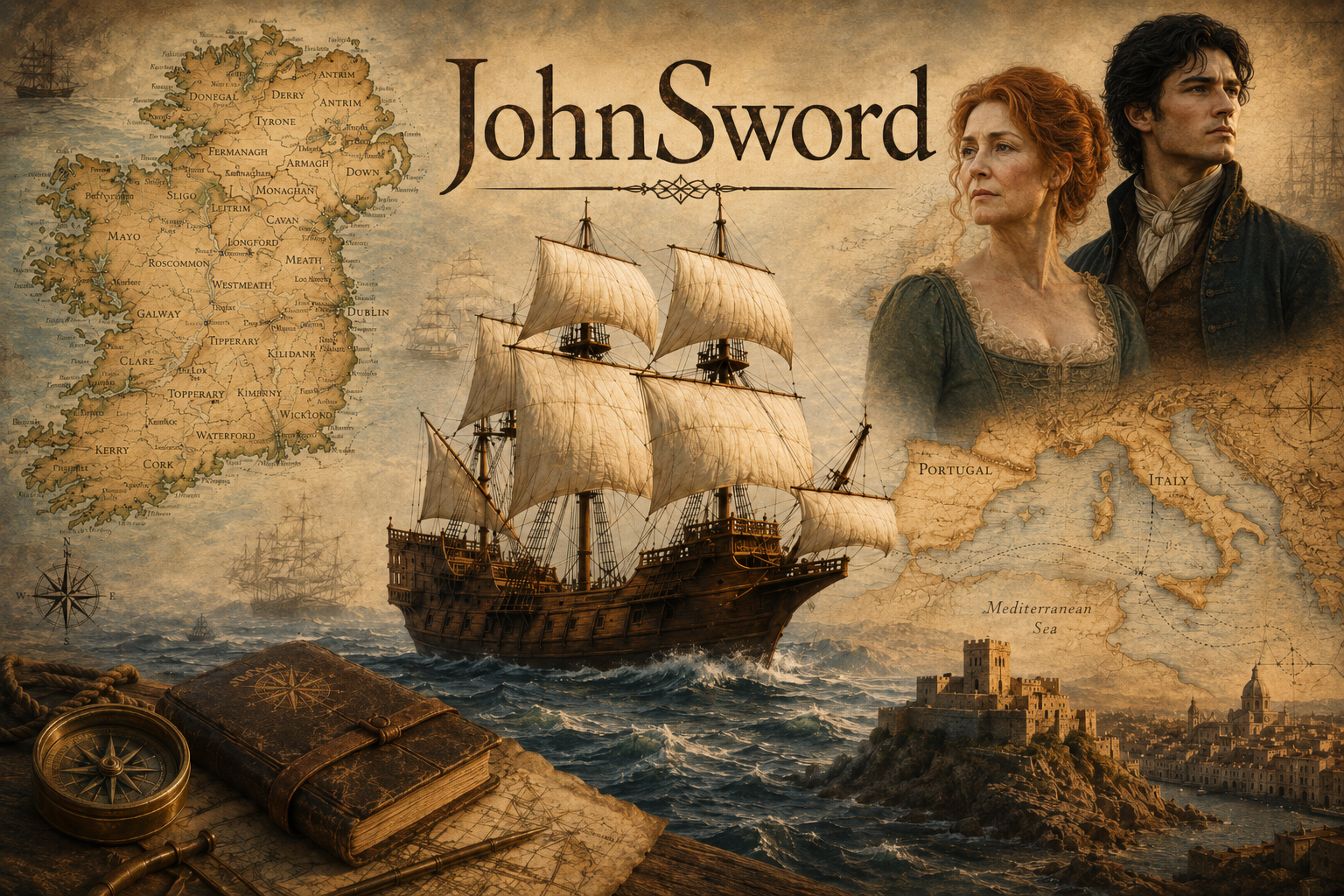
Chapter One
Boston & Cape Cod
All of four years of age and trying mightily to pay attention to his ship in a bottle models, I couldn’t help stealing glances high up the wall of an adjacent room.
“Yes, that is John’s sword. One day you will hold it,” Grandpa told me, “But not today,” and he showed me the latest model he’d began spread out on his desk.
Closer to the ceiling than any of the paintings or a mirror, even as a tike I couldn’t help but notice that this location for the scabbard and sword was out of context with the rest of the decor. Some days later, taking advantage of a lull in the day and belief that others were not paying attention, I took a stepladder and carefully struggled to discretely carry and open it. A few steps up, Grandpa Pete grabbed and hiked me off my feet.
“I am old and frail now. Still, I can lift and toss you about if I choose.” Then he set me down. “Don’t you ever try to do this again. Do you hear me?”
He asked with a certain menace in his voice. I nodded and was afraid. He was the kindest person I knew, and I’d never seen him angry before.
“In time, you will hold John’s sword. Waiting for this day keeps me alive, and I can wait a few years longer.” “I am sorry. It will not happen again,” I muttered while trying to stand up straight and show respect. He accepted and smiled at me before offering a hug.
We lived in the North End of Boston, and my parents took us, me and my infant sister, out to Eastham on Cape Cod to my maternal grandparents’ house.
Grandma had died when I was two, and now Grandpa Pete welcomed me and Betty.
A magical place out of the city, walks beside the coves and bogs was captivating. At night, the scenery played back in my dreams as it still does to this day.
The next summer, Mom stayed with us for a month or so, and while she tended to Betty, Grandpa Pete and I bonded over how wonderful it was to have bluffs and beaches mostly to ourselves.
“As a lad I dove from that cliffside, water’s cold even at the height of summer,” he told me while pointing to a rocky crag perhaps a hundred feet above the surf.
Keeping Betty back in Boston the next summer, I was alone with Grandpa when I turned six and then seven.
Then Betty, mother and I came to live with Grandpa. Dad explained to me about divorce and how he still loved me and Betty, and would come to visit us when he could, but I understood that life would be different now.
At the age of 10, after we’d brought in a bunch of firewood for his stove, Grandpa told me, “You are the man of the house.”
The year was 1957. Éamon de Valera was back in power in Ireland, and Grandpa Pete, who was always reading the newspapers and magazines, told me that he was, “Cautiously optimistic that things will get better under de Valera.”
“A Jew undergoes his bar mitzvah at 13. You are only 10, but you are big and stronger than most your age,” Grandpa told me. Then he called mother and Betty to bear witness as he placed a ladder carefully against his wall before waving me to climb up to bring down John’s sword.
Ascending the rungs was an emotional experience, and before arriving at the top I turned to look at everyone. Then I carefully removed the scabbard from its mounts and felt the weightiness as I slowly descended back to the floor.
Standing apart from me as he insisted mother and Betty also keep a distance, Grandpa pointed me to stand in a certain spot. Then he prompted me to remove the sword before accepting the scabbard and placing it lovingly across his wingback chair.
“Feel the weight,” he told me as I slowly waved the heavy sword. “You must never drop this sword. Do you understand me?”
“Yes.”
Now the exact memory of what next occurred eludes me. Grandpa Pete came close and shoved me hard so that I fell back over a chair he’d brought from the kitchen and positioned just for this reason. I came down hard, and it was quite painful. Mother screamed and began to rush to me.
Saying more than asking, “Hurts, doesn’t it?” Grandpa insisted her and Betty back, and mother obeyed her father’s instruction.
I nodded and affirmed that it did indeed hurt as I was bruised and seemed to be bleeding from where my back contacted the chair.
“Now look. You are still holding John’s sword.” Then he asked, “Do you understand what this means?”
With some effort, I stood up and answered, “I was told to never drop the sword. So, I held on even though you pushed me down.”
“Aye. Your father is Italian, but your mother is Irish. John’s father was Portuguese. But his mother was from Ireland. You are both Irishmen, proud and true, warriors.”
Mother was appalled and demanded that Grandpa apologize for such nonsense and for pushing me down.
“Yes. An apology is offered when one acts in haste, lashing out from anger or lack of imagination. I have thought about this moment since Paul was a wee baby. I could have punched him squarely across the face, but did not. I thought carefully before preparing this arrangement of items, even considered waiting longer, but the lad is big and strong and mature enough now. So I gave him the test, and he passed with flying colors,” Grandpa said as he gestured and smiled broadly.
“So, although my trick was unpleasant and perhaps unkind, you will live and sleep better knowing who you are and what you have inherited,” and he came in close to embrace and kiss me on both cheeks – something he’d never done before. Tears rained down on my face, and seeing my grandpa cry made me emotional.
“I love you Grandpa, and I accept your reasons,” and after sharing a long look into his wise eyes, I shifted to my mother and saw that she was moved by what was happening. Betty was confused, but she would discuss this with mother later on and frequently as she came to appreciate and understand the oddities of boys and men.
That evening, Grandpa began to tell me the story. At first, I just thought he had a fanciful imagination. Soon there were objects and points of the story that felt too real to be made up. I resolved to listen closely, and ask questions and learn about my family and heritage, but it was impossible to not pay careful attention to every word and nuance of the story.
“I was about your age when my parents began to tell me about a village along the River Shannon, powerful matriarchs in Portugal and a sword that was taken from an English nobleman. These were factual accounts of our ancestors from the Sixteenth Century, and I suppose you are wondering how we can know so much from so long ago? The answer is that if not for this sword and a rosary and several other wondrous things, I would not know of our ancestors at all.”
“You see Katherine and John are heroic figures, and in Ireland we celebrate and cherish our heroes. So, I will tell you about your ancestors and their many accomplishments, as you must when it is your turn to tell your children, and you have to pay careful attention and ask me questions if something is not clear to you.”
Chapter Two
County Clare, Ireland
Well, where to begin, where to begin? In Labasheeda, which means bed of silk, in County Clare right beside the River Shannon, that is where Katherine was born in 1504. Katherine was the second to youngest with her sister Megan just three years younger. Brothers Mark, Brian and Patrick were seven, five and three years older.
So, Katherine was a young girl with bright green eyes, freckles that seemed to always smile on their own and the most beautiful fire orange hair you have ever seen. By the age of twelve she could out wrestle, outrun and out spit any of the twenty or so children in her circle. Perhaps you’re thinking that’s all well and good, running and frolicking through the summer months with your friends, but what about the winters? Well, I’m glad you ask because Ireland does not get much snow in winter but it does get cold and dark, and this seems to separate slackers from scholars, and which group do you think Katherine belonged to?
You see, in those days there was no compulsory schooling for children. If your parish priest was kind, your parents could pay beyond their tithe to have a child or two taught to read and write and perhaps learn some mathematics, but little more was available.
Katherine’s Mother suffered from poor eyesight. She also had ‘spells’ or what we now understand to be epilepsy. But in these times seizures were thought to be of the devil, and people shunned her. So, she desperately required at least one of her children to care for her. As the only girls and the two youngest, much of this responsibility fell to Katherine and Megan. Still, from an early age Katherine had shown that she was unusually intelligent and curious. She’d hear a song in church just once and would recite it all week in perfect form, or she’d be able to recall details of a conversation from days or even weeks earlier. So, the local priest accepted what little payment her parents could offer to teach her.
Father Moynihan had attended seminary in the north. So, in addition to his Latin and Gaelic language books, he also had philosophical essays and histories in English. Katherine learned to read and write in her native Gaelic as well as the Church’s ancient Latin, but she also insisted the Father show her his English language books which she came to love and read voraciously.
So, when she began to have thoughts about boys and men it was not connected to the boys she’d grown up with or even to the men she saw tending to their farms or walking along the River Shannon. No, Katherine dreamed of heroes and tragic figures like Alexander and Julius Caesar and Aristotle, men who were learned and involved in shaping their world. But it was what happened one summer as she was maturing into a woman that led Katherine to make the most consequential decision of her life.
She was bringing home a pail of water when one of the boys ran up and started to chase her. Well, chores will get done in good time but a chase was her favorite thing in the world. Oh, she ran like the wind and loved the feeling of exertion and having her heart race and lungs strain for breath. So after a good long run she stopped to let the boy catch up. He did and then he said, “Oh Katherine, you’re so pretty. Come on now, give us a kiss.”
Well he’d never spoken to her like that. Years earlier she had picked up this boy many times when he’d cried from a scraped knee, tended to him when he had fever and even stepped in to strike a bigger boy who was bullying him when he was little. So, it was a shock now that he’d grown to hear him speak to her in such an insolent manner. But she just ran back to her bucket and didn’t think another moment about the incident.
A day later another boy spoke to her this way, and then groups of boys started to chase her.
Katherine became afraid because she could see the look of the wolf in their eyes, and knew that she could not fight off so many.
One morning while she was beating rugs on the line and could not hear or see anyone sneaking about, a pair of boys grabbed her. She broke free, but they chased her toward the house where three more boys were waiting to pounce on her. She fought back and kicked hard as a mule but the boys ripped at her clothes and chased her away from the house. She ran to the woods and thought she’d lost them, but once she’d calmed herself and tried to piece her clothing back together the boys reappeared and knocked her to the ground. She screamed and kicked and cried out.
All at once one of the boys flew backward. Then another boy was gone and a third until she was able to make out the shape of a tall man. In an accented voice he said, “No. Stop this.” The boys didn’t like it, but they recognized that they were no match for this seafarer. One boy chastised the man, and the seafarer struck him so hard with the back of his hand that the boy was knocked off his feet. Well, the remaining boys righted their friend and took off after that. “I am Roberto Augustin Hernan Gomes daMata,” he said, and he removed his coat and placed it over her shoulders so as to allow this lovely girl modesty after the attack. “I am Katherine,” she responded before asking, “Have you sailed here from far off?”
“I hail from Portugal. My ship has brought delicious apricots, dates and olives to sell,” and he handed her some dried apricots.
It was rare to enjoy an apricot in Ireland in those days, and they were indeed sweet and delicious. “Thank you, and thank you for”– but she didn’t know what to call the trouble with the boys.
He took his leave of her, and said she could keep the overcoat. Well, Katherine went right home and immediately found the best leaf of paper she owned and started to draw the handsome man from Portugal. He was lean and had raven black hair with streaks of grey, dark eyes and a strong jaw, and he strode in fine boots with a confidence she’d never seen before.
Mother called her close. She could not see well, but she recognized bruises, blood and torn clothes. “And where did you come by such a fine coat?” she demanded to know. Katherine tried to answer, but Mother criticized Katherine for enticing the boys, whipping them up and for being lascivious.
“I have behaved properly,” Katherine insisted, but her mother had always been stern and disapproving.
The next day Katherine finished her chores quickly. She brushed her hair and cleaned up the bruises as well as possible. Then took the coat and headed down to the docks. There was only a small area where ships came to call, and she found the ship straightway and thought it a sight to behold.
This ocean-going vessel was made from thick slabs of hewn wood with three masts and at least two decks that she could see from shore. She watched as men loaded Irish oats and barley in large barrels into the hold of the ship. There were also salted swine, beef and mutton hanging from racks drying out in the sun.
“Captain daMata,” she said with a curtsy before handing him the coat.
“You have a fine ship, Sir.” “She is the Lucia Madre,” he explained, which means Mother Lucy. “Would you like to see?” he asked.
She agreed and cautiously put out her hand. Well, when he took her hand in his it was like a jolt ran through her body. He was strong and graceful, and she could not help but notice how clean and pleasant this man smelled.
The captain showed her his crew quarters, the three large holds where so much commerce was exchanged, his map room, kitchen, dining area and finally the captain’s quarters.
“You have learned some of my language. I am grateful,” she told him. “I study English and Latin.” The captain leaned close and asked her in Latin, “Are you musical, Katherine?”
Well, he’d said her name, and to hear it in that masculine accent was thrilling. Katherine felt so mature and worldly. She answered in Latin that she wished to learn music, but her church does not possess an organ.
“I am fond of the opera. The pageantry and colors lift the soul,’ and he kissed his fingertips to display feelings that words could not convey. “My homeland prides itself on music.”
He was still holding her hand, and she thought of the holiday times when there was dancing. Now she wished for music so that she could dance with Captain daMata.
Well, it was considered very bad luck to have a woman on board a ship in those days, even when in port. So, as the captain’s men started to return to their ship, Katherine knew it was time for her to go.
“How much longer will you be here in Ireland?” she asked. “A few more days perhaps, until the meats are dried and ready to travel,” he replied.
Well, Katherine could not stop thinking about this man, this Portuguese sea captain.
He was so kind and handsome. The next day she cooked and cared for her mother, but she did not eat her portion. Instead, she bound up the meal and took it down to the ship.
“Thank you, Katarina,” the captain said, and she swooned to hear her name as it would sound in Portugal.
He invited her to sit and join in the meal. She sat but could not eat in front of this man. All she wanted was to watch him enjoy her cooking.
“Are you married?” she blurted out almost without realizing that she had shared her thoughts out loud, and then she struggled before calling him, “Roberto.”
He stopped eating and looked deeply into her eyes. He asked how old was she before sharing that his wife had died three years earlier. Katherine offered condolences but felt conflicted.
Before departing she hugged the sea captain. “You are the kindest man I have ever known.” He was so clean and his body firm and lithe.
“If I were younger,” and now he hesitated, “you would be a fine wife, Katarina.”
She walked home fighting back tears. The man would be leaving and she’d only just gotten to know him. Then out of nowhere the boys fell upon her and tore her best clothes. They touched her body and pressed themselves against her. Katherine fought like a lion. She broke free and punched so hard that she thought she’d broken her hand. Then she ran like the wind and once inside bolted the door.
Now she stood in the presence of her Father. He had always praised her for being so smart and helpful and virtuous. Now he called her horrible names and banished her from his home.
“May the Lord strike me if I have done anything to bring shame upon this house,” she told her mother and father, but the door was opened and she was put out.
As night fell and the cold crept into the woods, she cried and prayed to God to understand what she had done wrong, what it all meant and what she was supposed to do now? In the morning Captain daMata was sad to not have the lovely Irish lass come to the pier to see him off, as she had also been on his mind.
They were several hours out to sea sailing southward when a storm came up suddenly as is not uncommon on the North Atlantic. Things began to shift on deck and a rope snapped. A piece of rigging came down and broke a young sailor’s leg. His compatriots brought him below deck and after a consultation decided that the leg would have to be amputated. The injured young sailor cried out in agony.
Suddenly, a red haired girl appeared from the back of one of the holds and said “No, No,” and then again “No.” Katherine gathered a few short planks of wood and some twine. She went back to where she’d stowed away and produced a flask of whiskey.
She insisted the young man to drink and drink a good deal more.
“What is your name?” she asked in Latin.
“Diogo,” he responded through his anguish and pain.
She began kneading his leg to reset the bone, pausing to comfort when the pain became too much. Then she splinted the break so as to hold it steady until the bone could heal on its own. As she had tended to Diogo, the Captain was summoned to see that there was a stowaway. He had nodded to allow her to continue. Then he smiled when she looked up and met his eyes. She had the men gently load the injured sailor into a bunk. Now let’s pause here to consider a few questions: If Katherine was put out, then how did she have a flask of whiskey? If her good clothes had been torn in the fight with the boys, then how come they were not in tatters when she came out from hiding on the ship? How had she snuck past the crew to even get on board the ship?
Do you know the answer to all of these questions? Megan. Yes, her younger sister adored Katherine and wanted to be just as smart and virtuous and beautiful when she grew up. Megan had spied her sister and the captain twice. She had heard the gossip of these encounters come to her parents, had been present when her mother’s rage had convinced their father to put his elder daughter out, and Megan was determined to help Katherine.
So, the house had a back door and Megan spirited out some clothes and food and her sister’s hair brushes and rosary and even the flask of whiskey and then waited until her parents were asleep to go to the woods.
As sisters they knew each other’s hiding places. So, Megan did not have trouble finding Katherine. “I saw you with him,” Megan said as Katherine sat quietly sobbing.
“Saw how you looked at him, how you could not take your eyes off that man.
And I saw how he looks at you,” Then she paused to see Katherine’s surprise as she learned that her affections were reciprocated by the captain. “Don’t let him go. You belong with him,” Megan insisted, and she convinced Katherine to go down to the dock and wait for a diversion. “Just promise me that you will return one day. Promise me.”
Well, this was all but impossible. These ocean-going ships were like spaceships today. To dream of riding in one was an amazing thought, but to promise that you will come back was no small thing, and in Ireland in those days you had to be cautious indeed with your promises. Still, Katherine promised that if it were possible, if she could come back, then she would return. The sisters shared a final embrace and a good cry before figuring out how to accomplish their mission.
In the morning, shortly after sun up the men began tending to their salted meats and fussing over tying things down and topping up their fresh water containers. Megan stepped onto the far end of the pier and began to dance. The men were entertained by the smiling little girl and laughed and sang for her as they gathered to have a closer look. It wasn’t much of a diversion, but Katherine slipped past and went quickly down to the back of a storage hold. This was the most consequential decision of her life, and she made it after a great deal of soul searching and prayer.
Well, there was no turning back after the storm. So, the Captain made the best of the situation, and insisted his female passenger to accept his bunk in the captain’s quarters. Katherine swore that she would work to earn her keep, and she did. Everyday she tended to Diogo. Then, on deck she watched as the crewmen tossed twine with hooks into the water even though they caught precious few fish. She even started to learn phrases and words in Portuguese.
One afternoon she collected as much twine as possible and began to work it around a small piece of wood and then knot it before moving the wood up and circling it again before tying it off. She worked for hours and the sailors stole glances and spoke in hushed tones about the crazy woman and what was she doing.
Then, after she was done building a long net, she found cork pieces and affixed them as floats.
Towards the end of each day, the captain ordered his sails lowered. It was crucial to inspect them daily for tears, as a small rip untended could lead to the destruction of an entire sail, and that could be catastrophic on the open ocean.
So, while the ship was not cutting through the water but mostly just rocking with the sea, using one of the long pikes with a metal hook on the end, she placed the net into the water. Well, the sailors were curious now, and their curiosity became elation when she reeled the net back in a few minutes later and two fish were inside. A few more tosses of that net and she had collected enough fish for everyone to dine well that night.
Katherine cooked the fish using some of the spices that the sailors had brought from far off tropical places. She took a sizeable piece to her injured patient. He ate heartily but felt embarrassed the next morning when he passed the meal and had to endure the Irish woman turning him over and wiping his bum like he was a baby. She smiled and told him that there was no shame. Even though he could not understand her words, he was reassured by their tone. This young man would never forget how she had saved his leg and the days and weeks of her kindness as she tended to him.
Many years later Diogo would have a ship of his own, and he would bring Katherine and John home to Ireland. It was a point of honor for him, and he would accept no payment for the task.
Now I had mentioned that Katherine, who I will call Katarina for a while, began serious study of the Portuguese language, learning a few phrases and several words of vocabulary each day. What is interesting is that one of the sailors had a natural aptitude for teaching the language. This was because Mariano also had to learn Portuguese as an adult.
Marino was an African, and not just any African, but the darkest African fellow you might ever meet. Well, Katrina had never seen a black person before and such a difference was a bit scary to her at first. But he was quick to smile and invite her to touch his hair and skin and that sort of thing, and they became fast friends as Marino would point at the moon and tell her how to say it in Portuguese, Lua, and then repeat different phrases using the word – Voe para a lua, fly to the moon – and so on and so on. Well, this was immeasurably helpful as Katarina’s skill and command of the Portuguese language progressed markedly after striking up this friendship with Mariano.
The captain was pleased because he was increasingly able to converse with Katarina about more meaningful thoughts. He encouraged her to sit with him in the map room, and shared navigation and sailing lessons. But as they reviewed the maps one morning she was confused.
“Are we beyond Lisbon?” she asked.
“Yes, three days south,” the captain answered. Then he saw her confusion. “We are not going to Portugal.” Well Katarina was dumbfounded. “Then where are we headed?”
“Roma,” he smiled. “Irish oats, grains and meats fetch a fine price in Roma.”
“Rome? Rome?” she stammered, having trouble imagining the ancient city she had read about in so many books. That evening, as every evening, the captain escorted Katarina to her quarters. As he wished her a good night, as he always did, and kissed her on the forehead, this night she took his hand and asked him to stay. “This is no small thing. Are you sure, Katarina?” “Oh, yes,” she responded, and she pulled him close and kissed him the way a woman kisses a man.
Well, this part of the story will have to wait until you are older. You will just have to believe that Katarina had taken the measure of the man and she’d realized the difference between simple infatuation and true love.
Little Megan at a tender age had been able to see it right away, and now Katarina was no longer afraid to fall in love with Roberto.
There are a few things needing mention here. First, in the warm waters of the Mediterranean grew sponges. Yes, natural sponges are harvested in these warm waters. Such a thing was unknown in Ireland at this time. So, it was quite a shock when Roberto produced a sponge and immersed it into a pail of water before rubbing it under his armpits and across his belly. Katrina watched in amazement, and felt frightened when he insisted that it was her turn. Still, she raised an arm and allowed him to rub the strange sponge object soaked in seawater.
Well, it was a bit cold and odd and she giggled and squirmed, but Katarina was thrilled by their time in the captain’s quarters each night. She had never even thought about being nude in front of a man before, and had never before seen a man without clothing. It would have been scandalous and more back home, but now it was as though she had a right, almost an obligation to find happiness in this new life. Roberto had something amazing that was oh so rare back in Ireland during those days. He had a small mirror. Each night he held it so that Katarina could see herself as she brushed her flowing red mane. He watched attentively and was thrilled by the sight. Katarina just smiled and enjoyed his enthusiasm.
One morning she awoke and was sick to her stomach. She had been aboard the ship for nearly two months and not a moment seasick. Now Roberto held her hair back as she struggled and wretched. He dabbed cool water on her neck as he offered kind words.
That evening after she had viewed the stars using the sextant and recorded her readings along with others from the compass, she again became violently sick and threw up over the side of the ship. During this travail her rosary slipped from her wrist and went over the side and into the ocean. She screamed and threw up more and then fought to keep from crying as she remembered how grateful she’d been that her sister had the presence of mind to bring it that night which suddenly seemed long ago. After a few gargles of seawater and some deep breaths she was herself again. Roberto stood close and told her, “I love you, Katherine.”
Well, she thought it odd that he’d gone back to using her given name, but even more strange when he knelt down on the deck. Then he asked, “Will you be my wife?” before explaining, “We can ask for harbor at Gibraltar, two days sailing.”
“Yes, yes,” she replied, “I will be your wife,” but she wondered what was the hurry? She had read of Gibraltar, but somehow thought it was only a mythical place.
“You are young and innocent. Do you not know that you will have a baby?” he asked.
Well, she had cared for babies, and even assisted in delivering, but it took a moment to connect her bouts of sickness to his proposal. The realization made her feel secure and even more loved; this man would not abandon her when the going got tough.
The Spanish had recently driven out the Muslim rulers, but the central government was still struggling to secure unified rule of the country while all sorts of potentates and would-be kings continued to vie for regional power. This made a request for harboring at Gibraltar fraught with risk. You didn’t know who might be in charge or for how long, and the presence of a ship with a Portuguese flag might be seen as supporting one side over another. Still, Roberto took two of his crew in a rowboat to request permission. He returned and explained that they’d been granted three days and no more. Also, there was an aged priest up a hillside in a small church beside some pastureland.
At the pier there were sentries with pikes and knives. A headman of some kind came on board and went into the hold. Aside of beef and another of mutton were removed, this was the price.
Four crewmen were given permission to top up the ship’s fresh water casks. The rest were to stay aboard ship.
Roberto had a footlocker with a cranky, rusted lock on it. He struggled to get the mechanism to work before hauling back and striking the lock with a mallet. The captain gathered some items and put on good clothes, then took his intended up onto the rock of Gibraltar. Well, a wedding is a wedding. You thought I was going to go on about how romantic and the fine clothes and all that, didn’t you? Well, there are a few things to relate but not of that sort. First, at the appropriate moment in the ceremony Roberto reached into a pocket and produced the most exquisite ring you’ve ever seen, silver with an emerald. “You should have something to remind you of your homeland,” he explained.
Now isn’t that something? A sparkling green stone that she could look upon to always remember the green grasses of Ireland. She thought this the greatest wedding gift imaginable, but afterwards when they visited a secluded beach and Roberto stripped down and went into the surf for a swim, there was an even better gift.
You know Irish people of that time did not learn to swim. The waters are frightfully cold even at the height of summer. So, Katarina feared the water. Oh you should have seen her fretting about the water’s edge worrying about losing this wonderful husband she’d just wed while he went for a swim. Why she just stayed by the shore and watched terrified that he would drown or a sea monster would swallow him up. I tell you she was mortified.
Roberto wanted his wife to come and enjoy the pleasant water with him, but he was not the kind to force her. So, he did the shrewdest thing possible. He came out of the water and dried a bit before reaching into his trousers, which were resting on the branch of a small tree. Out came a lovely rosary that he showed off before walking back into the surf.
“Please, I want you to come and have this rosary. It belonged to my grandmother.”
She was frightened no more and stripped naked before cautiously wading waist deep into the waves. Roberto placed the rosary around her neck and kissed his lovely wife deeply. She was secure in his love and allowed him to take her out into deeper water and bounce her along the surf in his arms.
Katarina wasn’t so pregnant yet as to be showing, but she could feel the changes in her body and was thrilled by the prospect of a child.
One final thing occurred at Gibraltar, and it was not so nice. Katrina had never seen a monkey, and the island has loads of them. Modern day Gibraltar still has a unique species called Gibraltar monkeys, and they have a horrible reputation amongst women. This is because these monkeys for some reason not only steal wallets and shiny objects, they also grab women in private places before scurrying away shrieking. Well, this happened to Katarina and she laughed and told her husband that it might be time to get back underway to Roma.
On the open ocean mighty storms rage, and men die without mercy. But the true peril of sailing the Mediterranean was raiders and pirates.
Raiders are quick little boats that race out from a hidden cove or jetty or hide in plain sight on moonless nights before boarding a passing merchant ship to grab whatever they can before the crew has time to respond. A proper pirate ship is loaded with cannon and all sorts of other weapons and spoiling for a fight ahead of murder and plunder.
The sea between Gibraltar, at the mouth of the Mediterranean, and Rome, which is a middle point of the sea, was more tranquil than the Atlantic but loaded with pirates and raiders. In these waters sails did not come down at sunset, and full crews manned round the clock shifts with two men in the crow’s nest holding scopes to look well out across the horizon.
“We do not have cannon because the weight would slow us, and a merchant ship is no match for a pirate in a fight,” the captain told his wife. The very next night two pirates come upon them. Cannons roared and the crew wanted Katarina to go below deck. At first, she complied, but quickly reasoned she’d come too far to cower and would rather meet her fate on her feet as opposed to hiding below. Back on deck she saw that the men were petrified by the cannon and screams from the pirate ships.
Katarina shouted, “Make speed, make speed!” and she took one of the ropes for the top sail and began to pull. Only Mariano joined her in working to raise the sail. Then Diogo, who was now able to walk with a crutch, began to pull. Soon the rest of the crew fell in and heaved the sail to its fullest height, and the ship accelerated as the surface of the sail now captured more wind.
“Lucia Madre!” Katarina shouted “Lucia Madre! Again, Mariano and then Diogo joined in her cheer before others started to chant the name of their ship. “Lucia Madre, Lucia Madre!” Suddenly, screaming their ship’s name made them no longer afraid.
They were whipped-up and motivated, and this state of unity of purpose and action is the best thing in such moments.
Well. they outran the first two pirate ships but a third was in front of them and meant to block their escape. Now the men were staring into even more cannons. Katarina had an idea and so she climbed up to the crow’s nest to ask for one of the spy glasses. She didn’t bother with looking at their cannons, but instead examined the pirate ship’s sails and found a weakness.
“They’re mainsail is poorly mended. Tack to starboard!” she shouted to her Captain, “Tack to starboard!”
The cannons of a pirate ship are along her sides. So, if you sail straight at them, you provide the smallest possible area of your ship to be struck by cannon fire. The idea that Katarina had conveyed, and that Roberto understood, was to sail right at the pirate ship and then at the last moment tack as fast as possible to starboard so as to challenge their main sail to keep up so the pirate ship could maintain her best firing position. You see, the weight of all those cannons made the pirate ship much heavier in the water. This meant that there was more strain on their sails to push through a greater volume of water, and a hastily mended sail might fail. If it did fail, then the pirate ship would not be able to turn fast enough to fire any crippling shots.
As they came close to the pirate ship and then began to tack hard to starboard, a pirate ran across his deck and jumped onto the Lucia Madre.
He landed hard and started to come up with long knives in each hand. As this man was regaining his equilibrium Katarina threw a net over him. This was a heavier net made of rope instead of twine and considerably larger than her original net. Well, the man had to lower his knives to get out from under the net, and two sailors of the Lucia Madre rushed at him armed with fish knives. The fish knives were smaller and more agile than the pirate’s long knives, and the men gutted that pirate and tossed him over the side.
The Lucia Madre was able to out steer the pirate ship and then the main sail of the pirate ship started to rip forcing her to break off pursuit and turn back to mend the sail before waiting for their next target.
Chapter Three
The Mediterranean Sea
They continued a swift run through the night and were elated three days later when Frederico up in the crow’s nest spied the distant shore of Sicily. This meant that they were less than three days from Roma and safe because of shore patrols. The rest of the journey involved looking at the Italian coastline and waving to people along the shore.
Roberto had been correct, merchants in Rome paid top prices for Irish grains, oats and meats.
Katarina was pleased to know that products from her homeland were held in such high regard. Mariano explained to her that there was something in the climate and soils of her lands that produced the highest quality of oats and grains, and that the thick grasses of Ireland made for excellent meats.
Years earlier an influential family in Roma had asked Roberto to help them reestablish their shipping business. He had actually sailed under their banner for several years prior to becoming an independent merchant.
Anyway, whenever he was in Rome, the Pasquale family insisted Roberto stay at one of their villas.
Well, the villa was filled with art and had large windows. Katarina was so impressed because glass windows were rare back home, and these were so big. She had dreamed of sharing a proper bed with her husband and thought this would be the greatest part of staying in Rome. As it turned out, this proved one of the least amazing things. After they’d settled into their rooms, Roberto took his wife into an ante room and there were two girls filling a tub with scalding hot water.
“Please, your bath is ready,” he said with a sly smile.
Well, she’d never even dreamed of such a thing. The water was so warm and scented and they even added something to make bubbles. Can you believe that?
One of the girls began scrubbing Katarina’s feet, and it was lovely. She thanked the girl and smiled warmly as she waved for her to give them privacy. Then Katarina insisted her husband into the tub. Roberto was hesitant at first. He wanted to have his wife relax before a nap and then they were to attend an opera, but she wanted affection and to be close to him now, so he removed his clothes and obliged.
After the nap a gown was waiting for Katarina. It was odd for her to understand the concept of napping in the afternoon. Only toddlers and the very old took naps in Ireland; there were so many chores and not enough hours of sunlight, but she obliged and was surprised at how soundly she’d slept.
So, Katarina put on the gown and even tried the strange shoes that were the fashion. She had never walked in heels, and it was difficult at first but somehow fun.
When a woman came into her room and asked her to sit for her eyes, Katarina was baffled. They’d had not actually spoken to one another as much as the woman pantomiming by pointing at her own eyes. Still, Katarina sat still as the woman applied makeup around her eyes.
Now Irish women of the era did little more than wash their faces and brush their hair. But in Rome this woman used pins and such to put Katarina’s lustrous hair up in a fancy manner as well as painting her up like a doll.
When she looked in the mirror afterwards, Katarina hardly recognized the woman who looked back. She just smiled and wished her sister was present to see how glamorous and sophisticated she looked. She felt like a princess. There were no photographs back then, no text messages and no way to preserve the evening except through memories.
Well, a carriage drawn by a pair of beautiful horses took them to the opera house.
Katarina was pleased because Dantonio Pasquale had married Roberto’s sister, Gisela and this meant that the ladies could communicate in Portuguese with one another.
Roberto was dashing in his long frock coat and tight britches with fancy shoes and a hat. He said little but could not take his eyes from looking at his wife. He just beamed and smiled.
Oh, the opera hall was magnificent with statues and arches and high ceilings and seats that were soft and plush. Then the music started and actors began to sing in the most magical costumes with scenery that went up and down as the story changed locations.
Today if a movie goes on for more than two hours people are furious. We haven’t time, and need to call this one, or go to pick up something over here. Well, back in these times there were far fewer distractions. An opera went on for a minimum of four hours, and if it ended too soon people were sorely disappointed to have the magic stop so suddenly. Can you believe, they’d sit for at least four hours, sometimes eight hours and want more?
Even though it was all in Italian, Katarina could follow the story by the actions of the actors, and when the songs were sad, she knew why and when a love ballad sent shivers up her spine she swooned and squeezed her husband’s hand. Opera was more than she could have dreamed, and at the end she rose to her feet with the rest of the audience and cheered wildly as the actors came out to accept flowers and ovations and all the praise that their performances had earned. Roberto embraced his wife and kissed her passionately. Katarina wished this night would never end.
On the ride home she began humming one of the arias. Portuguese and Italian are both considered romance languages, and perhaps that closeness explains how Katarina came to start singing a song in a language she could not speak. Think about that, takes a pretty good memory to recall the sounds of words in a language you do not yet understand. By the time they were back at the villa all four people in the carriage were singing and laughing and then singing some more.
Katarina fell asleep almost instantly upon laying in the bed. She dreamed of the baby, and woke up knowing that she was carrying a son.
“This morning I will take you to meet the Holy Father Clement VII,”
Roberto said casually as Katarina ate some oranges and grapes. She convinced herself that he was playing a prank. Still, they walked a short way down a few avenues and turned and there was the Vatican.
Now today’s Swiss Guard are just ceremonial lads from Switzerland who don flouncy uniforms and tall hats for the tourists. But the Swiss Guards of Katherine’s day were rough men who stood ready to defend the Holy Father and their Church with their lives, and actually did so regularly as the politics of the era were treacherous and violent. Roberto was not fluent in Italian, but he knew enough to get by. He presented his letter from the Pasquale family, and told the guards his business with the Pontiff. Katarina’s cynicism that her husband actually knew the Holy Father gave way to a sort of breathless wonderment at the whole thought of being in this place. Well, they let the seafarer and his lovely wife pass, and the guards smiled at Katarina and bowed their heads as she walked by.
Much of the artworks and statues now famous were just being considered or worked on at this time, but the view from outside the Vatican was still something you had to stop and take in for several minutes to appreciate. There were fountains and gardens and windows of stained glass and so many elegant buildings to see.
Roberto led Katarina up some steps to a tall door and inside to a smooth marble floor that led to a room with a gigantic globe and a bible on a stand. Now that bible looked heavy enough that two or three men would be needed to lift it.
Katarina just looked about. She was awed by this place. A flock of bishops walked past. They were dressed in the finest robes she’d ever seen. Then a pair of priests came in and Roberto embraced one warmly. Katarina could not help but giggle at the strange custom of two men kissing each other on the cheeks. Men did not do this back home, but she rather liked the warmth of the ritual.
“This is Pablo. He is being elevated to Cardinal,” Roberto explained. Roberto had been close to his elder brother back in Portugal. “Eminence,” Katarina said with a curtsy to the soon-to-be Cardinal. Then she kissed his hand. The soon to be Cardinal smiled warmly and said a few nice things before commending his friend on taking a fine wife.
Well, the men had much to reminisce and talk about, and Katarina insisted that she was fine by herself. She wanted to see the great Vatican, and actually preferred to be let alone to wonder and experience.
She observed the grounds, a few exteriors of buildings with carvings and angelic motifs. Then she entered the chapel. There was high scaffolding as frescoes or paintings on the ceiling done right into the plaster were being done, large and more beautiful than any artworks she had ever seen. Then a man up on the scaffolding screamed down at her in Italian. Covered in paint and with wild hair and a bushy beard this fellow climbed down and became even more animated and angry.
Katarina did not know what he was saying but she had been around enough babies to recognize a tantrum. She walked up to the man and stared right into his eyes. Though he stopped screaming his breath alone was that of a wild bull ready to charge. Delicately she placed her hands on his head before guiding his face to rest in her bosom. This was not specifically Irish, but rather what you will come to know as woman’s intuition. When a child is over stimulated, you put his face to your bosom so that he tunes out the world, and then you stroke the back of his neck along the hairline to calm him.
Well, his arms covered in paint ruined her gown, but she did not care.
Katarina sung sweetly in Gaelic to this fantastic painter as she gazed up at his works. After a short while he looked up at her. In that moment she could see in his face the little boy still inside this man and understood his pain and struggle and desire to complete the ceiling. She whispered to him in Latin, “You are a gift from God, a gift,” before returning to her song. She could feel his tears and drooling, and accepted his pains unreservedly. In her peripheral vision she saw a group of prelates and an elder man who they all fussed over as they entered. “Praise God, and his Holy Father on Earth,” she said, again in Latin, as she tried to curtsy and maintain the artist at her bosom.
The painter understood what was going on and stood up allowing her to properly curtsy and then kiss the Holy Father’s ring. He smiled back warmly, and an assistant told her, “The Holy Father is pleased that you care for Michelangelo.”
The artist spoke with the Holy Father and they argued about something relating to Katarina. The Holy Father refused to allow his artist to redo Mary, as she was perfect. However, as an assistant to the Holy Father explained to Katarina, “Michelangelo wishes to paint you.”
You see the ceiling was quite large and there were several spaces where a fresco of an angel with beautiful red hair could work. Katarina was honored to pose for the Master, and accepted right there.
That evening Roberto told her, “My crew and I must sail to earn our keep. We will visit Sicily, and then Marseilles.”
Katarina did not like having her husband absent, but she understood the need to earn a living. She had wondered and now asked, “Why did you bring apricots, dates and olives to Ireland? Wouldn’t the English or French or even the Flemish have paid a better price?”
“Yes,” Roberto answered. He sat more upright before continuing. “Years earlier, when I borrowed to purchase the Lucia Madre, my money was short. So, I accepted work for the English, Liverpool to Dublin, a day’s jaunt each way. You carry troops and they pay handsomely. Transport horses and gear and the pay was still more. I thought ‘ this isn’t my conflict, so why should I care?’ But I saw what the English were doing, and I did care. That is why we call on free Irish ports.”
She kissed him deeply and told her husband that she was even more honored to be his wife. Then she made him promise to come home as soon as possible, and he promised. Katarina showed up the next morning to begin her modeling for the Master. She had brought him some fruit but ate it along the way as she was now eating for two.
A couch was provided so that she could be in repose or lying down.
The Master smiled when she first took to the couch, “No,” and he gestured that she must be without clothing.
Well, this was an interesting turn. She had not considered such a requirement. But Katarina trusted the great artist and did as he asked. She found being naked and pregnant for the artist somehow exhilarating.
Michelangelo did sketches and then more sketches. At times he came and touched her to assess ratios and the finer points of her body. It was not romantic, but still, she could not help but giggle at his inquiries.
One afternoon a theologian dressed in black entered the chapel. He called to her in Gaelic, and averted his eyes so as to not look upon her nudity. Getting up was more challenging as her belly was now extending from the growing baby inside. She put on a robe and walked to the man.
“The English, they have begun a spring offensive,” and the man shared a letter from Dublin.
Katherine was grateful for Dr. Callahan’s sharing, even though the news was horrifying. The English had begun to cut off the limbs of Irish people so that others would be frightened to resist them.
When the work was done Katarina was proud and pleased with the Master’s depiction of her, but troubled to figure out what to do about the English. She had come to realize that this ceiling in the Sistine Chapel might be around for hundreds of years, and she was honored to be a part of it.
Now I will tell you that the Irish visit the Vatican in large numbers, and they stare at the artworks and statues and then enter the great Sistine Chapel and gaze up at that ceiling. They find the red-haired angel with the glowing green eyes and Celtic features, and are uplifted by the presence of one of their own.
Well, a decade or two back saw a restoration of that ceiling to remove all the grim and crud from back before electric lighting when torches burned oils and soot settled all about the frescoes. So now people bring binoculars and such to see the greater detail and the Irish are even more uplifted because now even the freckles across Katherine’s face smile down on them.
So, a week after she’d finished posing for the master, she arrived in the grand palace of the Vatican in a gown that showed her growing belly. Her hair was up, fancy shoes on her feet and she’d had the woman do her eyes and cheeks with makeup.
A quartet of stringed instruments played lovely music as diplomats and their assistants mingled and discussed politics and events. Katarina watched and figured out who was the English Ambassador even before Dr.
Callahan nodded to indicate his identity. She smiled and curtsied as she moved past others, and then held nothing back when addressing Sir Beaumont.
“England England I call you,” she began in full voice at a distance as the players stopped playing. “By force of arms you steal Irish grain and livestock. You burn Irish homes and put women and children out in to the cold. Now you sever Irish limbs!” and she stepped closer to the ambassador. “What foul creatures of hell are the English?” she asked, and before he could speak, if he would have attempted to respond, she slapped the man.
Now it wasn’t the sort of slap to knock a man down, but neither did she withhold so as to only make the gesture only for show. Tears of rage and remorse flowed down her cheeks. Katherine knew that she had violated protocol and there would be repercussions. Still, she just glared at the man for a long moment before turning and walking out of the hall. Katherine had not just slapped this man in the company of his peers she had shamed an ambassador and his nation. Several nights later Gisela and Dantonio insisted her to attend the opera. Well, no sooner had they taken their seats when everyone in the hall stood and turned around to look at the red haired Irish woman. This theater full of Italian people applauded and cheered her. Katarina rose and bowed gracefully, but was conflicted about the adulation.
You see, Italy was not a united country as it is today. The Austrians held a large swath, and the Gauls or French also controlled a great deal of Italian territory. So, these people struggling against foreign oppressors identified with Katarina striking back against an English oppressor.
This matter became known as “The Incident” and Katherine the “Incident Woman,” and it was one of the first stories ever reported internationally in this new thing called newspapers. As the technology of the printing press spread all across Europe, more and more people were learning how to read so as to know what was going on in their world. It didn’t take long for wars and events to eclipse this little dustup at the Vatican, but for now the “Incident” made news all the way back to Ireland.
One more thing, the opera was a tragedy, and it stirred Katherine to resolve that she must write to the Ambassador and apologize. He was not to blame for his nation’s policies.
Dearest Sir Beaucamp:
I write to apologize to you, Good Sir. You do not make policy, and your very presence in Rome attests to the fact that you do not enforce your government’s policies in Ireland.
While the recent news of atrocities against my people was more than I could bear, I am deeply sorry for causing you harm and more so for any damage this incident has done to your career as a diplomat.
You have kind eyes and a greater self-control than I, and for that I commend you.
Should we ever meet again, I pledge to be more agreeable and to apologize properly as a lady.
With the deepest of respect and admiration, Katherine Daisy Maria ÓRiagáin daMata She was surprised when the ambassador wrote back to explain, “The apology is mine, dear lady. It is true that I did not participate in policies regarding your homeland, but my nation’s policies toward Rome and the Church are equally troubling. Accordingly, your actions helped to convince me to resign from my post and return to a position at university.
God be with you, Katherine.
Sir Arthur Douglass Beaucamp As is common among husbands, Roberto did not tell his young wife the whole truth about his planned trip to Sicily or about the next leg of the journey. There had been a blight that infected burden animals across Sicily, and now that the sickness had ceased there was an urgent need to replace these animals.
To take full advantage of this situation, the Lucia Madre would carry 17 horses over the three-and-a-half-day sail. Still, this required more than 25 barrels of water to maintain the animals as well as a great deal of hay.
So the deck, crew and captain’s quarters and even the map room and virtually any other place aboard ship that was not loaded with a burden animal or hay would be crammed full with barrels. This meant that the ship would be unusually heavy and slow in the water, and that even a small storm could potentially sink the vessel. Also, the extra weight was not evenly distributed, but concentrated up on deck so as to make the Lucia Madre dangerously susceptible to capsizing in a gale.
Well, the Lord smiled upon the crew and she arrived mostly unscathed. All of the animals survived, but not before leaving behind an awful mess. The way sailors dealt with this was to shovel beach sand into the holds and let it sit atop the waste material overnight before shoveling the whole thing out. Ironically, farmers paid a good price for this prized fertilizer material.
Italy was a leading producer of a few New World crops that had been brought over just a generation earlier in the time of Christobol Colon, who Americans know as Christopher Columbus. Tobacco, watermelons and especially tomatoes were all the rage, and Sicily seemed to be ideal for growing all of them. So, Roberto traded for large quantities of tomatoes both fresh and sun-dried, a significant number of watermelons and several barrels of tobacco. He also acquired spices like cilantro, oregano and peppercorns. Finally, the shortage of burden animals had not affected the water buffalos that were milked to make cheese like mozzarella and parmesan. So, Roberto bought sixteen barrels full of the cheese in brine water.
Well only a mild squall and some trouble with a sail occurred on the journey up to Marseilles. The markets paid welland merchants appreciated that Roberto’s always knew which items to bring. The only problem was that these Gauls had nothing to trade that anybody wanted.
Today everybody praises French cooking. But in these days French food was awful. Throughout this era and for hundreds of years afterwards French nobles only wanted to marry Italian women of status. This was because the ladies would bring their cooking staffs and spices, and that is how French cuisine was born, mostly by stealing ingredients and ideas from the Italians. So, Roberto came back to Rome with plenty of coins but nothing of worth to trade, rather like an empty tractor trailer dead-heading back to his warehouse nowadays.
Katarina was ravenous now, as she was truly eating for two. Pregnancy affects each woman differently, but most have odd cravings for certain foods and aversions to others that they used to enjoy. For Katarina she began to adore all the sweet fruits and vegetable of the region while losing her taste for meat. She also used to enjoy a good tipple, but now even the thought of some wine made her nauseous. Roberto had saved a few watermelons and some tomatoes for his wife, and he’d also acquired artichokes and something called bananas from trading with another seafarer.
“What is that?” Katarina asked with a quizzical look until Roberto opened a banana and showed that the fruit was inside. Katarina thought this delicious. Then he cut open a watermelon and she tasted. “Dear Lord that is heavenly,” she exclaimed before putting her face into the sweet fruit and devouring it. Then rising up to say, “Please tell me you brought more than just one.”
Katarina was well along now. So, an overland ride up to Florence would be bad for her health, and walking around Rome seemed also to sap her vitality. Mostly they stayed in and enjoyed each other’s company and played cards with Dantonio and Gisela in the evenings.
However, something miraculous happened just after Katarina gave birth to a son. Roberto had three grown daughters with his late wife, so he was over the moon with elation as he held a healthy boy in his arms. “Told you I was carrying a son,” Katarina bragged after only an hour or two of pain and perspiration during her labor. But the appearance of Roberto’s friend who was now a Cardinal was the truly amazing thing. It was what he said that brought Katherine to tears:
“The Holy Father wishes you to write to your family back in Ireland. The Holy See will deliver this private letter.”
Now you have to understand that in these times there was no postal service, particularly if you wanted to send a letter from one country to another. A few miles out of Rome, and banditry was the norm, as was true throughout most of Europe.
Katarina had dreamed about what she would like to tell Megan, how she wanted to share stories about life on the sea and the storms and rubbing small sponges dipped into seawater across her teeth and gums, and her husband and new son, and how delicious the fruits and vegetables were. She wanted to tell Megan that she’d been correct about Katherine belonging with this handsome Portuguese seafarer. Now having this chance reduced Katarina to tears of joy, and she kissed the Cardinal’s hand repeatedly as she thanked him over and over.
“Rest,” Roberto told her, “You need to regain your strength. Please, start to think about what to say in the letter,” and he and the Cardinal retreated to another room.
When Katarina first gave suckle, she was surprised at her baby’s appetite and that he smiled when she spoke to him in Gaelic. She thought about names, and John seemed to push its way into her mind. There wasn’t a grandfather or uncle, and nobody named John had left an impression upon her. It was just that John seemed to insist itself as the child’s name.
Italians believed that at least two weeks should pass before a newborn should venture from home. So, the new parents waited the appropriate time before traveling to the Vatican to have their child baptized by the Holy Father.
Now there was a funny thing about Clement VII. Katarina curtsied, kissed his ring and thanked him for allowing her to send a letter back to Ireland. The Holy Father smiled warmly as he waited for his assistant to translate her Latin into Italian. Pope Clement VII was a Medici, a member of one of the most powerful dynastic families in Italy. He was a consummate tactician of politics and his archrival was Henry VIII, the English king who defied the Church to divorce multiple wives as well as starting his own Church of England. So, when Katarina slapped the English Ambassador, she feared being barred from the Vatican and possibly even excommunication from the Church. Well, the Holy Father was delighted. He was thrilled that the incident became a public scandal. Perhaps he even helped to convince the newspaper publishers to continue writing about this story? However, as he waited for Katarina’s Latin to be translated into Italian, she realized that the man she regarded as God’s representative on Earth was not a good student of Latin.
At Roberto’s insistence, their son was baptized John Duncan Francisco Peter daMata ÓRiagáin. Now you might have noticed that his last name was the same as his mother’s maiden name. This was because Roberto reasoned that because he was much older than his wife, he would die first. Katarina would want to take her son home to Ireland. So, it was only natural for John to have a proper Irish family name.
Well Katarina had brought the rosary that Roberto gave her at Gibraltar on their wedding day – the one that had been his grandmother’s. A bit of holy water and some prayers, and it was blessed by the Pontiff. But then the Holy Father gave her a second rosary that he had also blessed, and it was gorgeous amber beads and silver fittings with a crucifix bearing intricate detail. The translator explained, “This is from Jerusalem. The Holy Father wishes you to have it.”
Katarina accepted the gift serenely but inside she was already certain that this prize belonged to Megan, and she would later ask if the Holy Father would be offended if she sent this beautiful rosary to her younger sister. He was pleased that she was so considerate, and asked if Katarina might like another rosary for her son when he is old enough. So, John also received a rosary blessed by the Holy Father.
Weeks earlier, the Cardinal had left leaves of the finest lily white paper, and ink as black as pitch as well as half a dozen quills. Now modern quills have a metal nib to make the writing a bit easier, but in Katarina’s time a quill was just a long feather which had to be re-cut regularly to keep the point sharp and continue the capillary action of the feather working to draw up ink when it was dipped into the reservoir.
Formal writing was about rhythm and a light touch so as to not cause too much ink to settle on the paper. You had to have a feel for how many words you could write before needing to dip your quill again, and it was important to stay in that rhythm so as to pen a good looking letter. After you finished, you had to wait and be careful so that the ink would dry and set into the paper properly. Well Katarina spent the entire two weeks after John’s birth and until they took him to be baptized thinking about and composing her letter. In the middle of the night, she would rise to jot down a few thoughts. As she continued to nap in the afternoons, again she would pop up to put down a few thoughts and then return to finish her nap. Several pages were for Megan, as both sisters had received schooling by the local priest, and a second section that she thought might be copied and read aloud in churches across Ireland, she composed for a broader audience.
Katarina wrote of how much the Holy Father loved the Irish people and saw that they were oppressed by the immoral actions of the English. Farmers, merchants and clerks were no match for a professional army, so she portrayed the contest as a challenge in which the opponent must be convinced of the wrongness of his actions in order to reform his ways. But she made no reference to fighting back or even organizing resistance for fear that her words would incite the slaughter of Irishmen and women in battle. Overtures to the French, Dutch, Spanish and Portuguese – the powers of that time – were a good idea, but Katherine realized that there were no good choices for the Irish at this time.
More than a year later, two Sundays after Christmas Mass, Father Moynihan asked Megan and her father to join him in his office.
“A letter has arrived from Rome,” he told them as he produced the large envelope with a papal seal that had been pressed into heated wax.
Then he asked Megan to open it and read the letter aloud.
Well, that rosary from Jerusalem fell out and Megan set it aside on the good Father’s desk. She was thirteen years old now, and shed tears of joy as she read aloud that her sister had married the handsome seafarer and recently (at the time of writing) bore him a son, John. They had already heard about the ‘Incident’ but could not be truly certain that it was their Katherine who had slapped the English ambassador. Now there was no doubt. Megan looked at her father and saw that the man looked down in shame.
Katherine praised her brothers—Mark, Brian and Patrick – and expressed well wishes and glad tidings to their wives and families. Then she wrote kindly of her mother and Father, and wished them good health and long lives. “I will return if I am able,” she promised. “Until then, please never question that I have always loved and respected both of you. I always will.”
Further down in the letter Megan learned that the rosary was a gift from the Holy Father, and that was from Jerusalem – and specifically for her. She raised it to her cheek and kissed the rosary as if it were her sister.
Katherine’s letter continued that she had learned Portuguese, hoped to bear more children and expected to eventually live in Portugal. “My heart is Irish, and my allegiance will never change, but my husband’s land will be my home.” She enclosed a copy of the letter she had written to apologize to the ambassador, as well as his letter in response, and commented that she had become comfortable in the company of powerful men.
“They are just boys who have endeavored a little further in their games, nothing more really.” They did not know who or what to make of Michelangelo or the Sistine Chapel, as this was 1522, and these things were not yet known, but then Megan unfolded a thick leaf of parchment to reveal one of the preliminary sketches of Katherine as an angel. Well, such things were scandalous in Ireland and remain so to this day, but Katherine was so angelic and her eyes and face radiated hope and salvation. It was comical the way Father Moynihan began by averting his eyes but could not help stealing a few glances before surrendering to delight in the charcoal drawing. A second leaf, which I have not yet mentioned, revealed Katherine and John as Mary and the Christ child. There had been another quarrel between the Holy Father and Michelangelo because the Master was not to alter Mary’s hair color to red or otherwise change her appearance. So, he drew Katherine with a kerchief so as to obscure her hair, and the baby John as big as life as he smiled in his mother’s arms.
Finally, there were several locks of Katherine’s beautiful hair carefully tied so as to keep from coming apart, and her Father sobbed and broke down into wailing after Megan handed one to him.